A letter shows up from a plumbing supplier you've never heard of. They're putting a lien on your house — because the contractor you already paid in full never paid them.
It sounds like a glitch. It isn't. It's one of the most common ways a finished remodel turns into a financial mess, and it happens to people who did everything right. Take a real case: in Utah last year, a homeowner paid her contractor about $43,000 in full — then a subcontractor recorded a lien on her home anyway. She wasn't alone: that one contractor's unpaid bills led to roughly a dozen liens on homes around her. After a storm in Pennsylvania, 17 families found liens on their houses when the roofer they hired didn't pay the shingle supplier.
Here's what a lien is, why paying in full doesn't always protect you, the small amount of paperwork that does, and what to do if one shows up anyway.
A mechanics lien can land on your home even if you paid your contractor every penny — because the people who can file it never had a contract with you.
What a lien actually is
A mechanics lien is a legal claim against your house, recorded at the county. Think of it like a legal cloud on your title — a claim attached to your property until it's resolved. It can be filed by someone who put labor or materials into your project but wasn't paid.
The good news first: a contractor actually forcing the sale of your home over a lien is rare. It's slow, expensive, and they'd have to prove the debt in court. The realistic damage is quieter but still serious — a lien clouds your title, so you can't sell or refinance until it's cleared. And to clear it, you can end up paying for the same work twice.
Why paying in full doesn't always save you
You have a contract with your general contractor. You don't have one with their plumber, their tile supplier, or the crew that framed your shower. But many people who provided labor or materials — including subcontractors and suppliers — may have lien rights if they aren't paid, depending on your state's rules. So if your contractor takes your money and doesn't pass it down, those unpaid parties can look to your house.
This isn't buried somewhere obscure. It's printed in your contract, in a section most people sign without reading. To show you, we'll use one real California remodeling contract as our example throughout the rest of this post. Here's the exact warning from it:
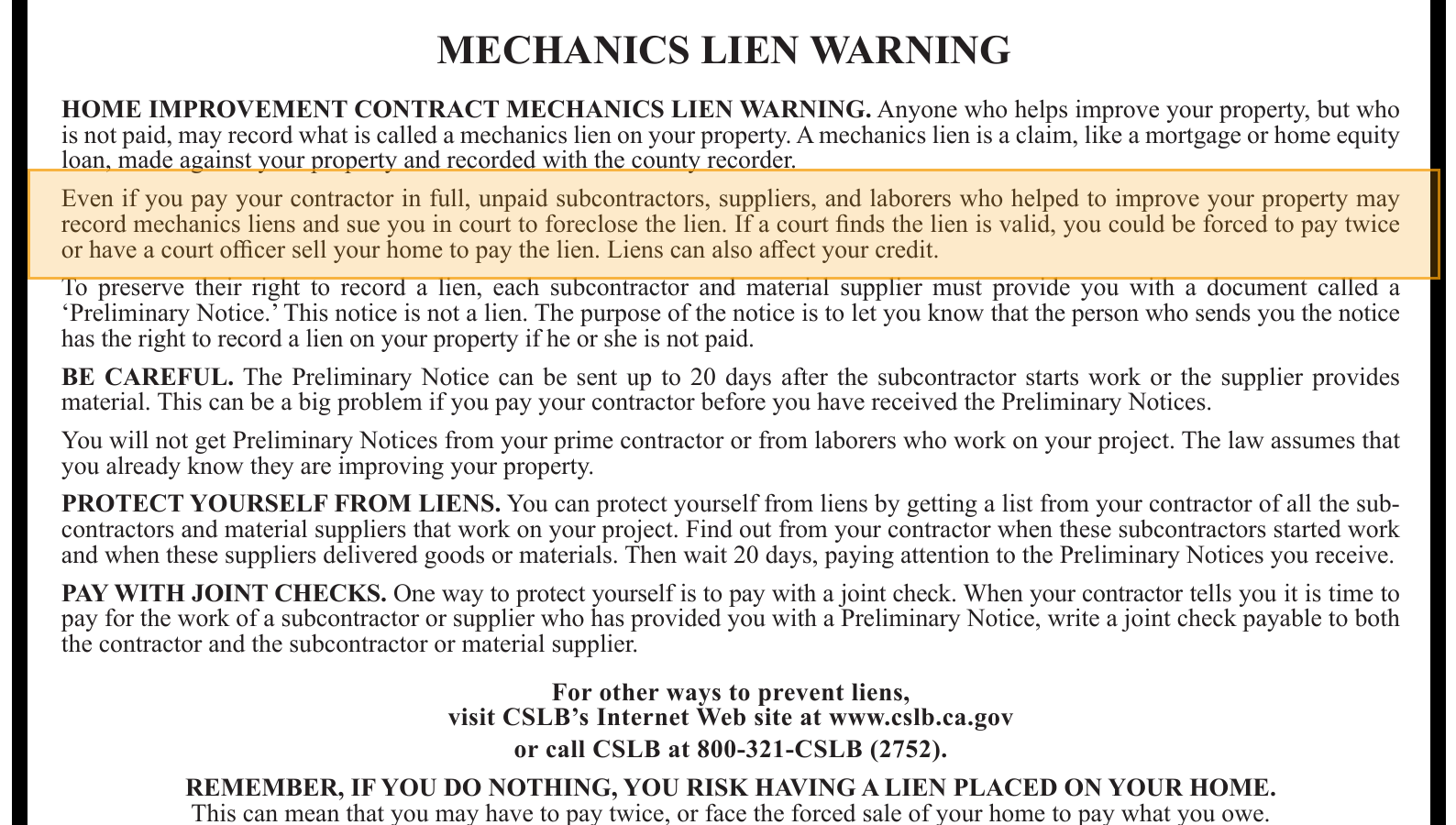
The Mechanics Lien Warning is required in California home-improvement contracts. The highlighted line is the part that catches people off guard.
Your contract probably also gives you one piece of protection: it requires the contractor to hand you a signed lien release before you make the next payment. Useful — but read closely, that often covers the contractor's own claim. It does nothing about the subs and suppliers, who the warning itself points to as the real risk.
The hidden multiplier: paying before the work is done
There's a second issue that makes the lien risk much worse, and it hides in the payment schedule. Look at the actual schedule from that same $44,500 contract:
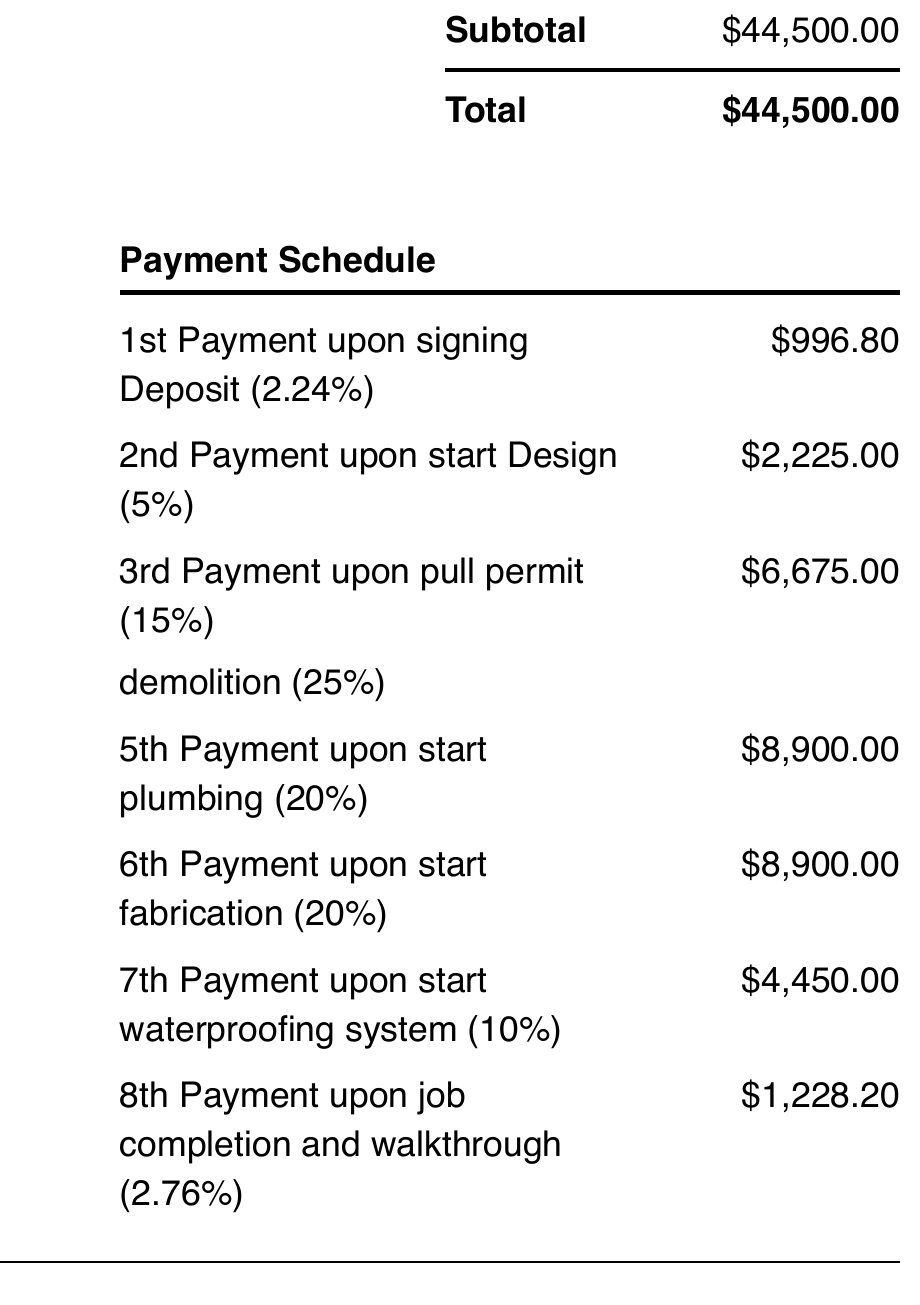
Real payment schedule from a bathroom-and-kitchen remodel.
Notice the trigger words: "upon start." You pay when each phase begins, not when it's finished. Add it up, and the picture is striking:
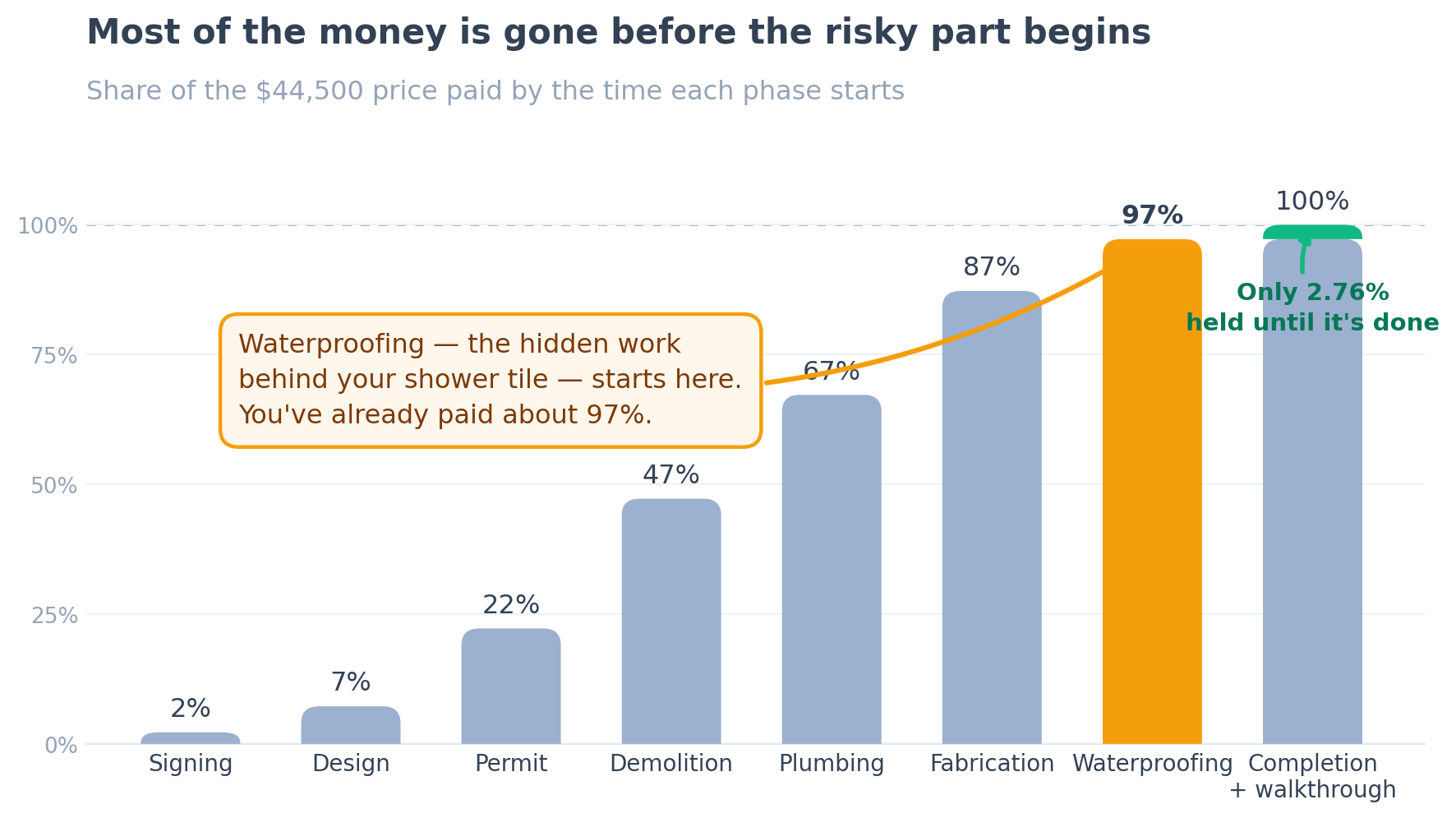
By the time the waterproofing — the hidden, leak-prone work behind your shower tile — even begins, you've paid about 97% of the price. Only 2.76% is held back until the job is done and walked through.
That matters twice over. If a problem shows up in that final, hard-to-see work, you have almost no money left to hold as leverage. And if a sub goes unpaid and liens your home, you've already handed over nearly all the cash that could have settled it.
How to protect yourself
Before anything goes wrong, most of this is simple paperwork — not a fight. Four habits do almost all the work:
1. Pay for finished work, not promises. This is the most powerful one. Tie each payment to a phase that's actually complete — and that's passed its city inspection, where a permit is involved — not to a start date. You're on solid ground asking for this: in California, it's against the law for a contractor to bill for work that hasn't been done yet. You're not certifying the quality yourself — you can't see behind a wall, and paying a milestone doesn't mean you've accepted hidden problems you couldn't have spotted. It simply keeps money in your hands as leverage. (And if your contract says moving in early counts as "accepting" the work, hold off on moving back in until the job is truly done.)
2. Insist on a real lien release — on the right form. You don't have to become the project accountant, but you should know who has lien rights on your job. Ask your contractor who worked on each phase, save every preliminary notice you receive, and before you hand over a payment, get signed lien releases covering that work — and not just from your contractor, but from the subcontractors and suppliers on that phase, because a release from the contractor alone doesn't stop them. One catch worth knowing: in California, a release only counts if it's on the state's standard statutory form. A casual note, text, or email won't legally waive anyone's lien rights. The forms are free — the state contractor board publishes them — so this is "use the right form," not "hire a lawyer." Then make each payment conditional on getting the release for the last one, once that payment has cleared.
3. Use a joint check when someone sends you a notice. If a supplier or subcontractor mails you a preliminary notice — a heads-up that they're on the job, not a lien — you can pay that phase with a check made out to both the contractor and that supplier, so the money can't skip them (and still collect a release for that amount). You don't need to hunt down a full roster; just respond to the notices you actually receive.
4. Agree to hold a little back — in writing, up front. Build a retainage into the contract: keep about 5–10% of the price until the final walkthrough, so the last, hard-to-see work still has money attached to it. Decide this before you sign, though — quietly withholding a payment the contract already says is due can put you in breach (this contract, for example, charges 18% a year on late payments). The 2.76% held back in the schedule above is the opposite of what you want.
What if a lien shows up anyway?
Sometimes you do everything right and a lien still lands — because a contractor took your money and didn't pay someone down the line. If that happens:
- Don't panic, and don't ignore it. It won't take your home overnight, but it sits on your title until it's cleared, so it does need handling.
- Tell your contractor in writing, right away. Clearing it is often their responsibility — check your contract's labor-and-materials or lien language, which usually makes the contractor responsible for paying the people they hired.
- Be careful with any remaining payments. If there's still money left under the contract, don't rush to release it while an unpaid-subcontractor lien is unresolved — but don't simply stop paying, either. Check your contract, put your concern in writing, and consider getting advice before withholding a payment the contract already says is due.
- Check whether the lien is even valid. Liens come with strict rules and deadlines. In California, for example, whoever filed it generally has only 90 days to actually sue to enforce it — and if they don't, you can ask the court to remove it. Just know that even an expired or invalid lien sits on your title until you take that step, so don't simply wait it out.
- If you need to sell or refinance now, ask your title company or a construction attorney about a lien release bond. This can sometimes move the lien claim off your title while the payment dispute continues, but it isn't free or automatic — in California, for example, the bond generally must be 125% of the lien amount.
- As a last resort, paying the unpaid subcontractor or supplier directly may be the fastest way to resolve a valid lien — but only if you confirm the amount, get the correct signed release, and make sure the recorded lien is actually released. From there you can pursue the contractor through the state licensing board, their bond, or small claims court, though recovering the money isn't guaranteed.
It's not just California
Mechanics lien rules exist across the country, but the details vary a lot by state. Some states require early notices. Some limit what an unpaid subcontractor can claim. Some give homeowners extra protection if payments were handled correctly.
The practical takeaway is the same almost everywhere: before each payment, know who worked on the job, know who sent you a notice, and collect the right lien releases before money leaves your account.
Three things to remember
- A lien can hit your home even after you've paid in full — the person filing it may never have had a direct contract with you.
- The likely harm isn't losing your house; it's a frozen title and the risk of paying twice.
- Lien releases, joint checks, and holding a little back are cheap and routine. A good contractor won't blink.
Before the next payment, know what your contract says
RemoDone reads your remodeling contract and turns the scary parts — payment milestones, lien warnings, warranty language, and contractor promises — into a clear checklist you can track. Upload it and see what your payment schedule, lien warning, and release requirements actually say.
Quick answers to common questions
Can a subcontractor put a lien on my house if I paid the contractor? In many states, yes. If a subcontractor or supplier provided labor or materials to your project and wasn't paid, they may have lien rights even though you paid the general contractor. The exact rules depend on your state.
Is a preliminary notice the same as a lien? No. A preliminary notice usually isn't a lien. It's a heads-up that someone worked on your project and is preserving their right to file a lien if they aren't paid.
What should I ask for before paying my contractor? Signed lien releases from the contractor and the subcontractors and suppliers tied to that payment. If a supplier or subcontractor has sent you a notice, consider paying that phase with a joint check.
Does a text or email from my contractor count as a lien release? In California, not reliably. To actually waive someone's lien rights, the release generally needs to be on the state's standard statutory form — a custom note, text, or email usually isn't enforceable. The good news: the forms are free and standardized.
This is general information from people who've watched a lot of remodels — not legal advice. If a lien has been filed against your home, talk to a construction attorney in your state.