When my contractor refused to fix a failing shower pan, I went back to the contract looking for the 10-year warranty he'd mentioned during the sales pitch. I found one clause: a 1-year workmanship guarantee. No 10 years anywhere in the contract.
That sent me down a rabbit hole I wish I'd avoided. Here's what I learned.
Most homeowners assume their remodeling contract warranty is the whole picture. It isn't — and understanding the difference can save you a lot of stress.
The 1-year clause in your contract isn't generous — it's the floor
Almost every remodeling contract includes a 1-year workmanship warranty, sometimes called a "callback" period. It covers problems caused by how the work was done: tile that lifts, cabinets that go out of alignment, caulking that cracks, paint that peels.
California actually mandates this. Civil Code § 900 guarantees a 1-year express written warranty on fit-and-finish items — flooring, walls, countertops, cabinets, paint, trim. If your contract doesn't include one, the law creates it anyway.
So the 1-year clause isn't a perk. It's the starting point. The question is whether your contract builds on top of it.
Different parts of your remodel are covered for different lengths of time
The construction industry uses a tiered framework — commonly called 1-2-10 — because a cracked grout line and a sagging beam aren't the same kind of problem.
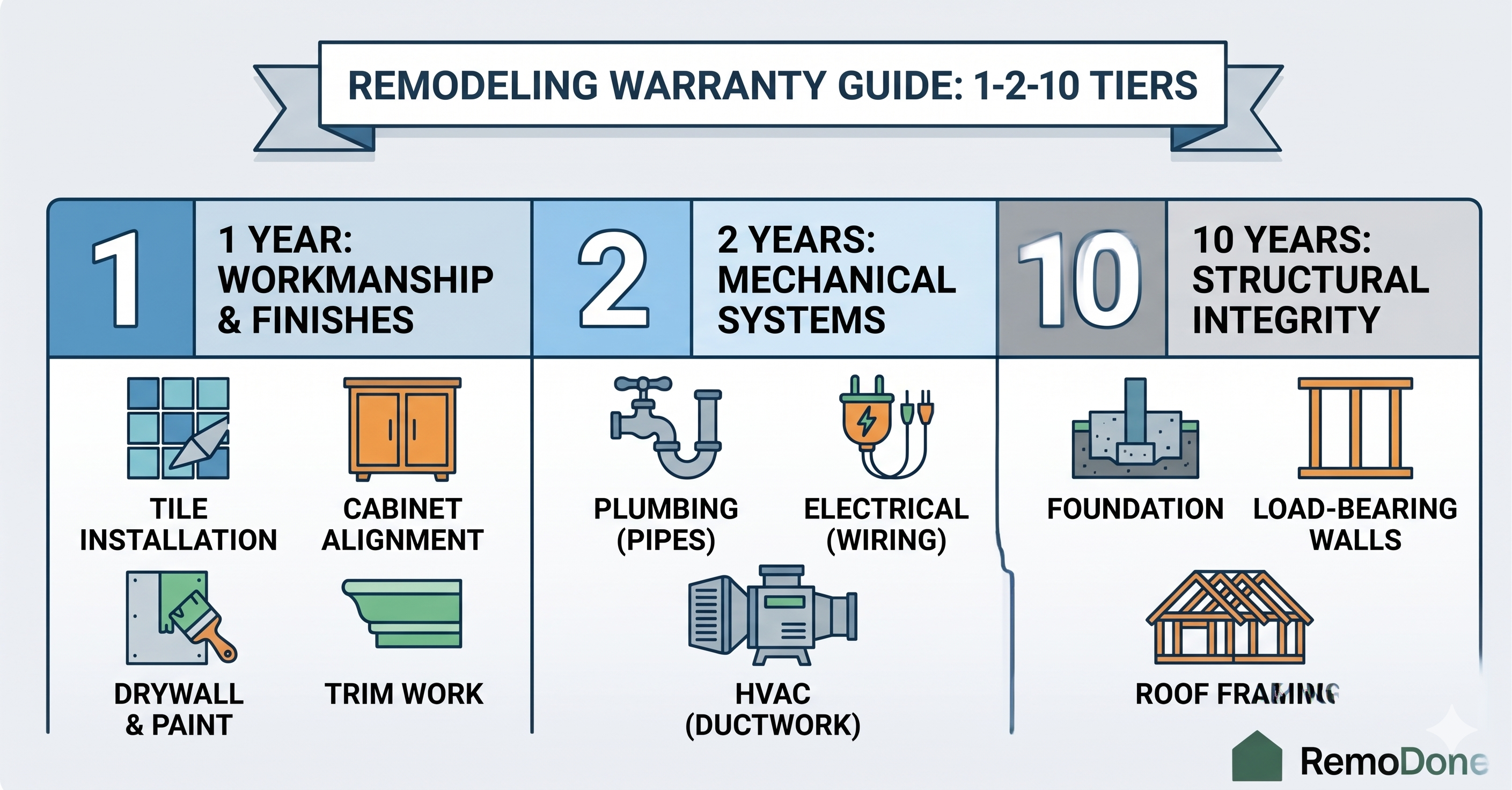
1 year — workmanship and finish work
How things were installed: paint, drywall, flooring, tile grouting, cabinet alignment, fixture installation, trim work.
2 years — mechanical, electrical, and plumbing systems
The infrastructure your contractor installed — pipes, wiring, ductwork. Not the appliances themselves; those come with their own manufacturer warranties. Worth asking your contractor which manufacturer warranties apply to your project and whether they'll register them on your behalf.
10 years — structural
Load-bearing elements: foundation, beams, load-bearing walls, roof framing.
One honest caveat: 1-2-10 is the standard for new construction. For a remodel, it applies to whatever scope your contractor actually touched. But if someone moved a load-bearing wall or poured new foundation and is only offering 1 year on everything — that's worth questioning.
What the law adds, regardless of what your contract says
Even if your contract only mentions 1 year, the law can extend your protection well beyond that:
A contractor can write a 1-year warranty and call it their final obligation. But these protections exist independently of your contract. If a structural defect shows up years later, you may still have legal standing — "warranty expired" isn't necessarily the end of the story.
None of this is legal advice. If you're in an active dispute, talk to an attorney.
Before you sign: get the details in writing
A generic "1-year warranty on all work" sounds fine until something goes wrong. Electrical not working is a different problem from a waterproofing failure — they carry different risk, show up on different timelines, and should be covered differently. Before signing, go through your scope of work and ask your contractor what warranty applies to each category. Push for it to be written into the contract. If they won't do that, a clear text or email exchange works too — "I'll warranty the waterproofing for 5 years" in writing is far better than a verbal promise you can't prove. A contractor who can't give you specific answers here is worth paying attention to.
If you've already signed: you have more protection than you think
A 1-year warranty clause isn't a trap door. The law protects you independently of what your contract says — 4 years to act on obvious defects, 10 years on hidden or structural ones. Those clocks run from when the work was completed, not from when you discover the problem, so the key is identifying and documenting issues as early as possible. And don't overlook your old texts and emails — if your contractor made specific commitments outside the contract, those conversations may matter more than you think when it counts.
The contract is one piece. It's not the whole system.
We built RemoDone for exactly this moment — when you're staring at a contract and not sure what you're looking at. Try it free.
No warranty clause in your contract at all? You're not unprotected — but you need to know where to look. That's next.